

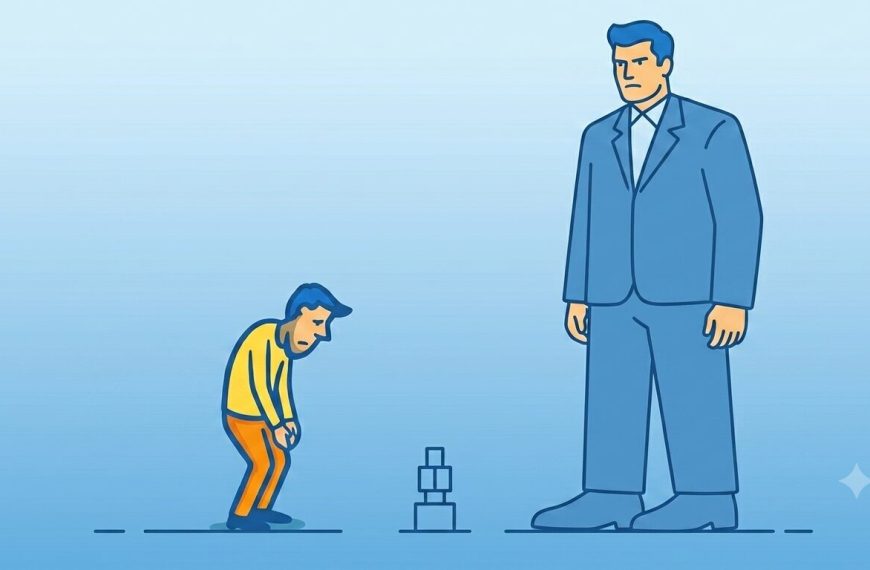
There is a feeling most of us have encountered at some point, either firsthand or through someone close to us. A quiet, unsettling conviction that the next person is doing better, or simply is better, and that whatever you are falls short by comparison. You hear it spoken out loud sometimes. She’s better than me. He’s better than me. Those thoughts are poisonous, and once entertained, they have a strong likelihood of staying.
This isn’t a piece about self-discovery or how to climb out of that hole. It’s asking something simpler and more uncomfortable: why do people assume their entirety is less than another person’s?
The Proof We Never Questioned
Social media has made this worse in a very specific way. It hasn’t just shown us other people’s lives, it has given comparison a face, a name, and a highlight reel. And when something has a face and a name, it stops feeling like a feeling and starts feeling like evidence. People genuinely believe that whoever they see on a screen is doing better. Not in one area. Just… better. The scroll becomes a verdict.
What makes this particularly cruel is that most people carry at least one thing they are quietly uncomfortable about. Social media finds that thing with uncomfortable precision and holds it up next to someone who appears to have it handled.
The Ladder Goes Deeper
Surface comparisons start with lifestyle and appearance. But they don’t stay there.
The next rung is money. Who has more, who is further ahead, who seems to have cracked something you haven’t. That comparison carries weight because it feels measurable. Concrete. Like there’s a scoreboard and you’ve seen where your name sits.
But the most diabolical comparison is the one that reaches your principles. When you begin to question not what you have or where you are, but who you are. When someone else’s choices make you doubt your own values, your integrity, the code you have lived by. That is no longer comparison. That is erosion.
Where We Came From
We grow up in different environments, different circumstances, shaped by things we didn’t choose and influences we can’t always name. Those things form us more deeply than we often acknowledge. They are not flaws to apologise for. They are the architecture of who we are.
Take bullying. There is a well-established psychological pattern that traces it back to envy, which is ironic when you sit with it. The person inflicting the pain is frequently envious of the person receiving it. What looks like dominance is often a cover for inadequacy. Comparison, taken far enough, doesn’t just wound the person being measured. It corrupts the one doing the measuring.
The Corrosion
In this global, hyper-connected landscape, our identities are slowly eroding. Not through dramatic collapse but through quiet substitution. The next person seems better, so we borrow from them. Then from someone else. We sand down the edges of ourselves trying to become a composite of everyone we’ve decided is more.
But here is the question worth pausing on.
Have we ever actually stopped to look at the people we’ve decided are better, and genuinely asked: what makes me less? Not as a defence. As a real inquiry. Because the honest answer, in most cases, is nothing. A different path. A different timeline. A different set of circumstances. Not less.
And if we all became each other, chasing the same ideal, moulding ourselves into whoever the algorithm decided was winning this week, who then would we see?
A world where everyone becomes their comparison has no one left worth comparing to.




Interesting piece