
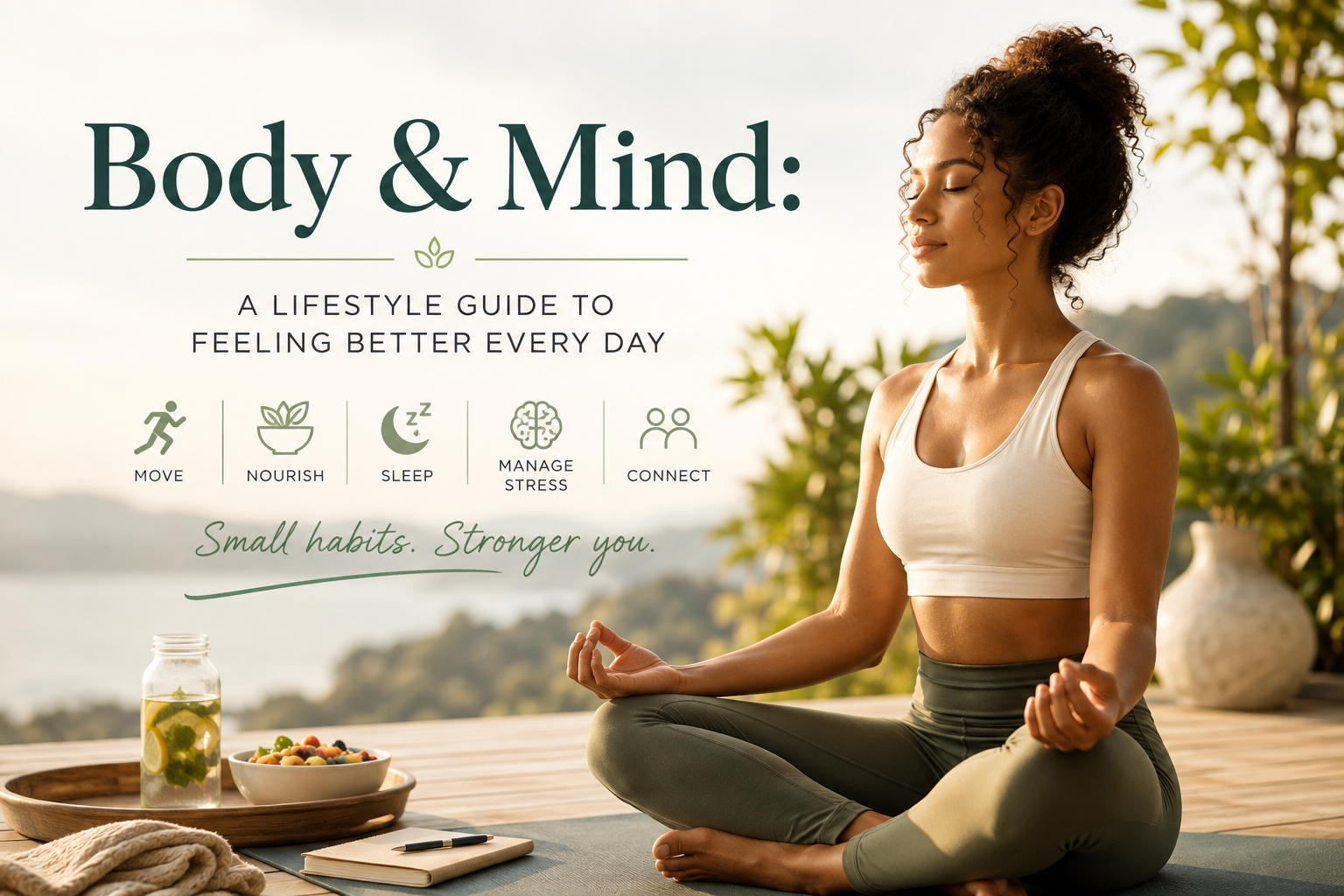
Feeling better doesn’t always require a dramatic transformation.
You don’t need to wake up at 5 a.m., drink something green that tastes like lawn clippings, or completely reinvent your diet to take better care of yourself.
For most people, feeling healthier is built through smaller things—the walk you take when you could have stayed on the couch, the meal that actually leaves you feeling energized, the extra hour of sleep, or the moment you decide to step away and breathe.
Physical and mental wellbeing are often treated as two separate things. One belongs in the gym, the other somewhere deep inside your head.
In reality, they are constantly talking to each other.
How you sleep can affect your mood. Stress can affect your appetite and energy. Movement can clear your head. The people you spend time with can influence how you feel long after the conversation ends.
Taking care of your body and mind isn’t about achieving some perfect version of yourself. It’s about creating a lifestyle that helps you feel more present, more energized, and a little more like yourself.
Move in Ways You Actually Enjoy
Exercise has a reputation problem.
For many people, the word immediately brings up images of exhausting workouts, complicated routines, and the feeling that if you’re not sweating dramatically, it probably doesn’t count.
Thankfully, your body is far less interested in whether your workout looked impressive.
It simply benefits from movement.
A walk around your neighborhood. Dancing while cleaning the house. Taking the stairs. Stretching after a long day at your desk. A weekend football game with friends. A gym session when you’re in the mood.
It all counts.
The key is consistency, and consistency becomes much easier when you choose activities you genuinely enjoy. A workout you hate but force yourself to do for two weeks is rarely more useful than a simple routine you can maintain for months.
Movement doesn’t have to dominate your life to improve it. Sometimes, 20 or 30 minutes of walking can be enough to reset your energy and give your mind a break from the noise of the day.
The goal isn’t punishment.
It’s use.
Your body was made to move. Giving it opportunities to do so is one of the simplest forms of maintenance available to you.
Eat to Feel Good, Not to Follow Rules
Nutrition can quickly become overwhelming.
One week, a particular food is being praised as essential. The next week, someone online has decided it is secretly ruining your life.
Trying to keep up can make eating feel more stressful than it needs to be.
A healthier approach starts by paying attention to the bigger picture.
Are you eating enough foods that provide real nourishment? Do your meals leave you energized or constantly searching for another snack? Are you drinking enough water? Are you eating in a way that feels sustainable for your lifestyle?
You don’t need every meal to be perfect.
Vegetables, fruits, protein, healthy fats, and fibre-rich foods can form a strong foundation, but there is still room for enjoyment. Food is nourishment, but it is also culture, comfort, celebration, and sometimes just a really good meal.
The aim isn’t to develop a complicated relationship with your plate.
It’s to build one that supports your life.
Pay attention to how different foods make you feel. You may notice that a balanced breakfast helps your concentration, or that staying hydrated improves your afternoon energy.
Your body is constantly giving feedback.
Learning to listen can be more useful than following every new food trend that appears on your timeline.
Don’t Underestimate the Power of Sleep
There is a strange habit in modern life of treating exhaustion as evidence of ambition.
“I’m running on three hours of sleep” has somehow become a productivity badge.
Your body, unfortunately, did not agree to this arrangement.
Sleep is when much of the restoration happens. It’s where your body recovers, your mind processes the day, and you prepare for whatever tomorrow decides to throw at you.
When you’re consistently tired, everything can feel harder.
Motivation drops. Small problems become irritating. Healthy choices require more effort. Even simple decisions can feel unnecessarily complicated.
Getting enough sleep won’t solve every problem in life, but it can make you better equipped to deal with them.
A consistent bedtime, fewer screens before sleep, a comfortable sleeping environment, and paying attention to late-day caffeine can all help.
You don’t need a complicated nighttime ritual involving twelve products and a Himalayan sound bowl.
Sometimes, the most effective habit is simply going to bed.
Your Mind Lives in Your Body Too
Stress doesn’t only exist as a thought.
You can feel it in your shoulders. In your stomach. In the way you breathe. In the headaches that seem to arrive after particularly demanding weeks.
This is why mental and physical wellbeing can’t really be separated.
When your mind is overwhelmed, your body often notices.
And when your body is neglected—when you’re exhausted, inactive, dehydrated, or constantly running on empty—your mental state can feel the effects too.
The good news is that small physical actions can sometimes create mental space.
Take a walk.
Step outside.
Put your phone down for a few minutes.
Take a slow breath.
Sit somewhere without trying to consume, respond to, or solve anything.
These things might sound simple because they are simple. That doesn’t make them insignificant.
You don’t always need to completely escape stress. Sometimes, you just need to interrupt the cycle long enough to regain a little perspective.
Take Care of Your Mental Wellbeing Before You’re Completely Drained
Mental wellbeing isn’t about being happy every day.
That would be exhausting in its own way.
It’s more about noticing what is happening within you and giving yourself permission to respond to it.
Maybe stress shows up as irritability.
Maybe you start sleeping poorly.
Maybe you withdraw from people, lose interest in things you normally enjoy, or find yourself constantly feeling like you’re trying to catch up.
Recognising these signs doesn’t mean you have to immediately fix everything.
It simply gives you somewhere to begin.
A conversation with someone you trust can help. So can taking time away from constant notifications, spending time outdoors, journaling, practicing mindfulness, or creating boundaries around the things that consistently drain you.
And sometimes, the best next step is talking to a qualified mental health professional.
There is nothing dramatic about asking for help when something isn’t working. We seek professional support for the rest of the body. The mind deserves the same practical care.
Connection Is Part of Wellness Too
You can eat well, exercise regularly, and sleep eight hours a night—and still feel disconnected.
Wellbeing isn’t entirely an individual project.
Humans need people.
Not necessarily a massive social circle or a phone full of unread group chats, but genuine connection.
A conversation where you don’t have to perform.
A friend who checks in.
A family meal.
A shared laugh.
Time spent with people who leave you feeling lighter rather than drained.
In a world where it’s easy to stay constantly connected online while feeling surprisingly alone, meaningful interaction matters.
Sometimes taking care of your mind means reaching out instead of withdrawing.
Sometimes it means putting the phone down and being fully present with the person sitting across from you.
Build Habits Small Enough to Survive Real Life
The problem with dramatic lifestyle changes is that real life eventually interrupts them.
Work gets busy.
You travel.
Your schedule changes.
You get tired.
The perfectly designed routine collapses because it was built for a version of you who apparently has unlimited time, energy, and motivation.
A sustainable lifestyle has room for imperfect days.
Instead of trying to change everything at once, start smaller.
Take a short walk after lunch.
Add something nutritious to a meal you already enjoy.
Stretch while the coffee is brewing.
Put your phone away a little earlier.
Call someone you’ve been meaning to talk to.
The small things may not feel impressive in the moment, but repetition gives them weight.
And when you miss a day—as everyone eventually does—the goal isn’t to punish yourself or declare the entire routine a failure.
Just begin again.
That ability to return is often more valuable than perfect consistency.
Feeling Better Is Not a Competition
There will always be someone online with a more complicated workout, a stricter diet, a more impressive morning routine, and a suspicious amount of free time.
You don’t have to compete.
Your version of wellbeing should fit your actual life.
It should consider your schedule, your responsibilities, your personality, and the things that genuinely make you feel good.
Maybe your best form of exercise is dancing.
Maybe your favourite way to reset is cooking.
Maybe you need quiet.
Maybe you need people.
Maybe today, taking care of yourself simply means getting enough sleep.
The goal is not to optimise every minute of your existence.
It’s to create enough space for your body and mind to function well.
Move when you can. Eat in ways that nourish you. Protect your sleep. Pay attention to stress. Stay connected. Rest without feeling guilty.
You don’t need to become a completely different person to feel better.
You might just need to take slightly better care of the person you already are.
And that can start today—with something small.